

A bit of history
A venerable plant, the hibiscus has origins stretching back to antiquity (3300 to 525 BCE). It is quite impressive that a plant has such a long history. It is known that hibiscus was cultivated in Egypt and also in the Southeast Asian region. Could the hibiscus flower be what we often see depicted in Egyptian hieroglyphs?

Over these many millennia, hibiscus has had time to travel around the world, and today it can be found almost everywhere. It thrives where conditions allow it to grow naturally. If not, it is grown in nurseries and sold by plant vendors.

It is notably the national emblem of South Korea, Hawaii, and also Malaysia, and it is depicted almost everywhere when tropics, warmth, and exoticism are mentioned. And for good reason! The hibiscus, which is called "Island Girl" in some places, comes from tropical, warm, and sunny regions, where it grows naturally as a bushy shrub reaching a height and width of several meters.

The Hibiscus rosa-sinensis
There are different species of hibiscus (at least 200) and hundreds of varieties. The Hibiscus rosa-sinensis, or China Rose, which will be discussed here, is probably the best known. It is believed to have been imported into Europe from China, which is how it got its name.
It belongs to the Malvaceae family, and there are many varieties that come in numerous cultivars resulting from horticultural hybridization. Hibiscus rosa-sinensis is not a perennial in Quebec. Its hardiness zones range from 9 to 11, which corresponds to tropical or subtropical climates. That said, your plant will be very happy to spend the summer outdoors once temperatures are mild.
The inflorescence
When grown in good conditions, Hibiscus rosa-sinensis are vigorous flower producers, which is their main appeal. Depending on the variety, flowers can range from 2 to 10 inches (5 to 25 cm) in diameter and come in various colors (red, yellow, orange, cream, apricot, lavender, chartreuse, peach, pink, purple, etc.). They are funnel-shaped and have 5 rounded petals curved back towards the peduncle. Some cultivars have slightly curled, crinkled, and sometimes double flowers. From the center of the flower, often with a colored eye, emerges a very long style and reproductive organs that are a true work of nature. On the style, several stamens (male organs) with yellow anthers (containing pollen) are visible, and at the end of the style are the stigmas (terminal parts of the female organ), which are generally the same color as the petals (although this varies in hybridized cultivars).
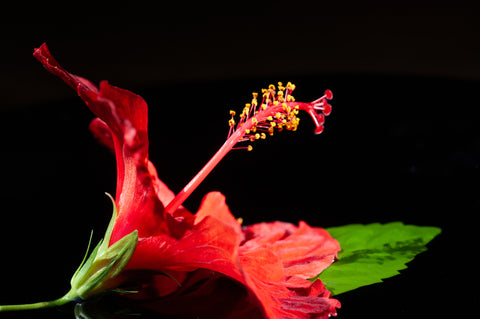
Hibiscus flowers, however magnificent, are a fleeting pleasure, lasting only 24 hours, barely longer for some hybrids. Therefore, there's no need to worry if the flowers fall off at the end of the day.
Below, we will look at some collector cultivars, each more spectacular than the last. Some have flowers that change color throughout the day, depending on sun exposure. Despite the beauty of the various hybridized specimens, the red-flowered one, which is the original color, is probably the most resistant of all.
Leaves and stems
The leaves are a rather dark green and glossy. Some cultivars have variegated foliage. The leaves are elliptical, serrated, and generally quite robust. The hibiscus has a woody stem, like a tree. In commerce, you can find specimens grown on standards and also specimens with braided stems.
Care and advice
Hibiscus rosa-sinensis needs sun. Many houseplants don't like direct sun, but they absolutely love it. This intense exposure, combined with a supply of fertilizer (for flowering) from April to September, along with adequate watering, will contribute to optimal flowering.


The Hibiscus rosa-sinensis needs thorough watering as soon as the soil is dry to the touch. It is best to keep the substrate slightly moist at all times. Under water stress, the plant will have soft leaves, which may turn yellow, and the flower buds could fall off. This is why you should consider a rich potting mix, capable of retaining moisture while still being well-draining.


It is important to maintain high relative humidity (ideally a minimum of 50%), especially during winter in our homes, where the air becomes dry due to heating. You can increase the ambient humidity with a humidifier. Some sources mention that misting is helpful, but a humidifier is better, as micro-droplets are more easily absorbed by plants. In case of dry air, you might observe flower bud drop and yellowing leaves.
It’s a good idea to take your hibiscus outdoors in the summer when the temperature is mild enough. They will be very happy. Before it gets warm enough to do so, you can stimulate them a bit to wake them up from their winter dormancy. You can restart fertilizing them with traditional phosphorus-rich fertilizers, but you can also give them a nutrient boost that will enrich the soil, make it more organic, and facilitate nutrient absorption by the plant. Gaia Green's Super Fly insect frass is rich in essential nutrients. It can be mixed into watering water or potting soil. It helps combat fungal diseases and promotes good health and better immunity in plants. The slow but easy release of nutrients provides a rich source of chitin and beneficial bacteria and fungi for the soil. With the summer sun, your hibiscus should thank you.

Many people bring their hibiscus indoors too late in the fall, and the temperature difference between inside and outside is a shock for the plants, causing them to wither. We recommend bringing them indoors no later than the end of August.
Hibiscus rosa-sinensis have a rather rapid growth rate, although hybrids grow a bit slower. If they become sparse or too large, they can be pruned. Keep in mind that since flowers are at the ends of branches, pruning will delay flowering. A tip borrowed from Larry Hodgson, the Lazy Gardener, is to prune gradually rather than cutting everything at once. He advises, if your growing conditions are good, to get into the habit of pruning one or two branches by two-thirds every three months. This would be a way to ensure there are always mature branches to produce flowers while rejuvenating the plant.
Pests
Unfortunately, Hibiscus rosa-sinensis are quite popular with certain harmful sucking insects that feed on their sap.
It's not uncommon to see aphid colonies infest them, particularly concentrated on flower buds, as they prefer softer parts. One way to get rid of aphids is to cut off the most affected parts, rinse the stems under a strong stream of water to dislodge as many individuals as possible, and then apply a treatment. Just one aphid remaining on the plant can lead to a new infestation. They reproduce very quickly.

Sometimes hibiscus plants are attacked by whiteflies (small white flies), which often congregate on the undersides of leaves. A good mechanical way to combat whiteflies is to vacuum them up with a vacuum cleaner. After that, it's good to apply a treatment to ensure no individuals remain who could reproduce.
In winter, in homes where relative humidity is often very low due to heating, Hibiscus rosa-sinensis are often targeted by spider mites (tiny mites). Regularly showering and misting your plant can be a way to mechanically combat spider mites, as they do not like humidity.
Mealybugs also attack Hibiscus rosa-sinensis. They like to hide in the branch axils. Since they move very slowly, they seek out undisturbed spots. Mealybugs are a bit tougher than other insects because they are covered in a protective layer that resists insecticidal soaps. The best way to get rid of them is to dislodge them, one by one, with a cotton swab soaked in rubbing alcohol. It's not a bad idea to spray the plant with rubbing alcohol afterwards, as they carry their eggs and babies on their underside, and sometimes the mother is eliminated but the young manage to escape.
And thrips... one of the most difficult pests to eradicate, as they have several developmental stages that occur in various parts of the plant, including inside plant tissues and even in the substrate. You need patience to get rid of thrips and regular treatments.


Obviously, in all cases, we recommend the least harmful treatments for the environment, such as insecticidal soaps and black soap, for example. Ideally, regardless of the type of infestation, treat once a week for a few weeks to ensure you get rid of it. You can also try to control pests with predatory insects that will eat them! It's quite satisfying to watch them work! However, you should not use an insecticide treatment AND introduce predators at the same time.
For more information on Hibiscus rosa-sinensis pests and control methods, you can consult the Espace pour la vie website.

Toxicity
Hibiscus are not toxic to humans or animals. Senegalese, Guineans, Malians, Beninese, and also Egyptians make a juice from infused dried flowers, which is absolutely delicious: bissap. "Bissap" is the name given to the variety of hibiscus used, Hibiscus sabdariffa (do not try with your Hibiscus rosa-sinensis). In addition, hibiscus is known for its therapeutic properties and used in different ways (antiseptic, diuretic, menstrual pain, cough, respiratory tract, hypertension, cholesterol, etc.). If you wish to discover it from this perspective, please consult a health professional for instructions and to ensure you consume the correct variety of hibiscus.
Collectible Hibiscus
Here are a few specimens from the 'Hollywood' series, which are available at Serres Lavoie. Hibiscus from this series are known for their abundant flowering, good growth, and good disease resistance.
We invite you to visit our website to discover the complete collection.
Hibiscus rosa-sinensis 'Hollywood Gossip Queen'
The Hibiscus rosa-sinensis 'Hollywood Gossip Queen' has orange-yellow flowers with a center that comes in different shades of pink, ranging from darkest to lightest and ending with rather light tips that contrast with the color of the petals.

Hibiscus rosa sinensis 'Hollywood America's Sweetheart'
The Hibiscus rosa sinensis 'Hollywood America's Sweetheart' has pure and luminous pink flowers, with a very red center. The closer you get to the edge of the petals, the paler the pink becomes, almost turning white.

Hibiscus rosa-sinensis 'Hollywood Disco Diva'
The Hibiscus rosa sinensis 'Hollywood Disco Diva' has slightly crinkled orange flowers resembling gold. The center of the flower is such a dark red that it is practically purple, and it is haloed by a pale pink border that creates a magnificent contrast.

The Hibiscus rosa sinensis 'Hollywood Earth Angel'
The Hibiscus rosa sinensis 'Hollywood Earth Angel' has soft white petals that seem to shimmer in the sun. This specimen will be perfect for brightening up a colorful flowerbed or for making the colors of other plants stand out more.

The Hibiscus rosa-sinensis 'Hollywood Heartbreaker'
The Hibiscus rosa-sinensis 'Hollywood Heartbreaker' has very orange flowers. Its great peculiarity is that, unlike most other hibiscus that have a pink or red center, its own is rather white, with a very pale pink margin.

The Hibiscus rosa-sinensis 'Hollywood Pop Star'
The Hibiscus rosa-sinensis 'Hollywood Pop Star' has vibrant pink flowers and a purple center. The colors are very saturated, and there are no gradients or pastel shades in this cultivar. The petal margins are slightly frilly.

The Hibiscus rosa-sinensis 'Hollywood Rico Suave'
The Hibiscus rosa-sinensis 'Hollywood Rico Suave' has very bright canary yellow flowers. Their center is cherry-colored and is haloed by a slightly lighter pink. This cultivar has very dense colors, and their contrast will not fail to make it a real attraction.

There is a wide variety of cultivars, each more spectacular than the last. Pay a visit to our greenhouses to discover them!


